
Criminal Cases in the Dawson County Courts
Dawson County criminal cases do not share one clerk or one docket. Felonies belong to the 106th Judicial District Court, with the District Clerk serving as file custodian. Class A and Class B misdemeanors begin with the County Clerk. Fine-only state charges and ordinance cases remain with the Justice of the Peace or Lamesa Municipal Court that heard them. That split controls where a search begins and which office can issue a certified copy.
The case file records what prosecutors actually filed. Call the District Clerk at 806-329-3315 for a felony or the County Clerk at 806-329-3311 for a Class A or B misdemeanor. The arresting agency keeps its own report, and the jail keeps the booking file. Those records can point toward a case, but neither replaces the clerk's docket or final order.
Dawson County Felony Case Split
The offense grade gives the fastest routing clue. Capital, first-degree, second-degree, third-degree, and state-jail felony cases go to the Texas District Court. Class A and B misdemeanor cases go to the county court. A Class C matter may remain at a justice or municipal court. Dawson County's Justice of the Peace is at 400 S. 1st Street and answers 806-329-3324. Lamesa Municipal Court can be reached at 806-872-4343 or courtclerk@ci.lamesa.tx.us for its fine-only city docket. A reader should check the charging paper or citation before calling, because a payment screen cannot retrieve a Dawson County felony judgment.
The Dawson County Clerk's official page is the local source for the misdemeanor office. Its captured page shows why the county and district clerk channels must stay distinct.
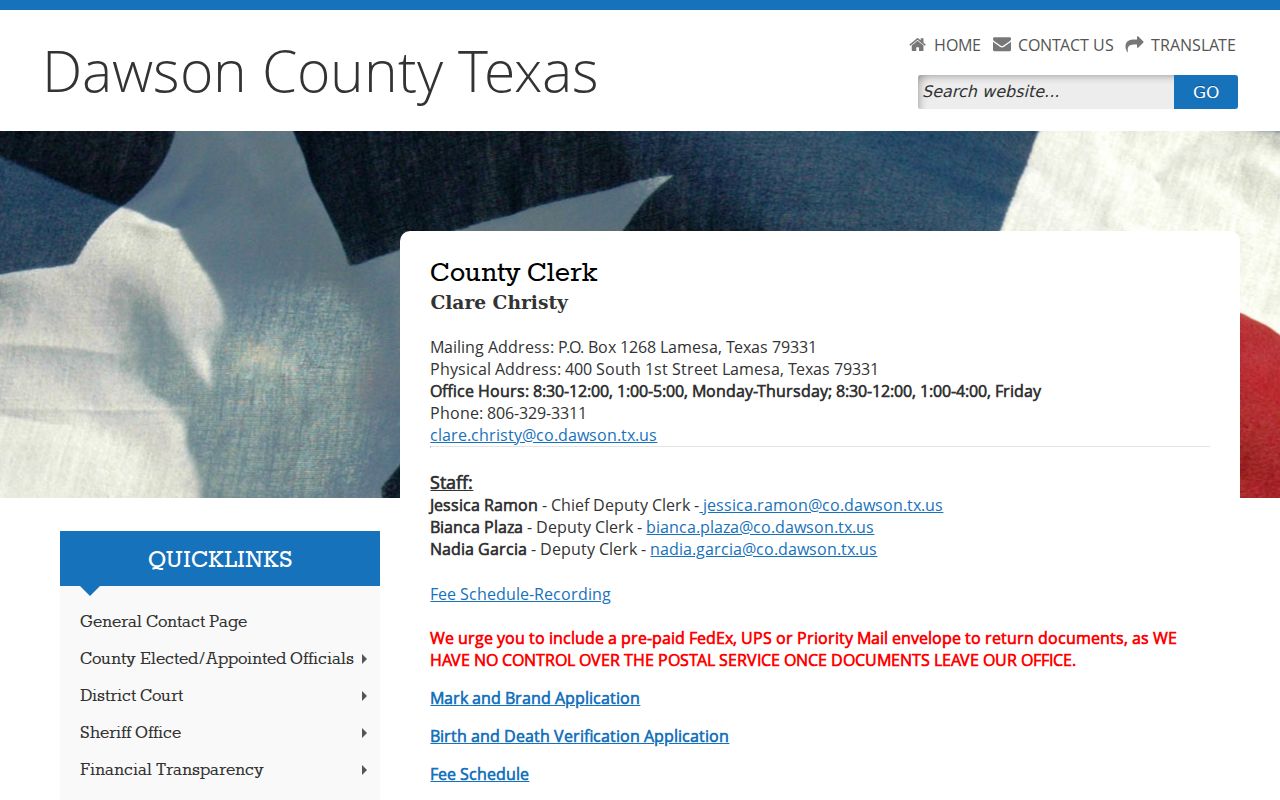
Use the County Clerk for Class A or B files, then ask separately for the docket, charging instrument, disposition, and any certified judgment needed.
How to Search Case Records
No Dawson County hosted criminal-case portal was verified. A sound search therefore pairs the correct local clerk with re:SearchTX, whose coverage and document access vary by court and user role. Registration is required. An exact cause number is more reliable than a broad name search, especially when names are common or older files are not digitized.
- Identify whether the charge is a felony, Class A or B misdemeanor, or fine-only matter, then choose the district, county, justice, or municipal clerk.
- Search re:SearchTX by exact cause number when possible. A party name can help, but it does not prove complete Dawson County coverage.
- Filter by Dawson County court, criminal case type, and a useful filing or event date range when those controls appear.
- Read the docket from the first filed charge through the latest order. Do not stop at the first charge label.
- Call the file-holding clerk for missing images, older matters, archived records, or certified copies, and confirm any search or copy charge first.
| Field or control | Type | Required | Use |
|---|---|---|---|
| Person or business | Tab and text | One search mode | Search party names while allowing for spelling and aliases |
| Case number | Tab and text | One search mode | Best route when the exact cause number is known |
| Location or court | Filter | No | Choose a participating Dawson County court |
| Case type | Filter | No | Select criminal when offered |
| Date range | Date filter | No | Narrow by filing or event dates |
| Search or clear | Button | No | Run the query or reset the criteria |
re:SearchTX and Dawson County Cases
The statewide platform is a useful first check, not a promise that every Dawson County criminal case or image is online. Participation, registration, charges, document visibility, and user access can differ by court. Older files, certified judgments, and documents withheld from remote view still require the clerk. A blank result should prompt a local call, not a claim that no case exists.
The official re:SearchTX landing page illustrates the state entry point and its registration-based access.
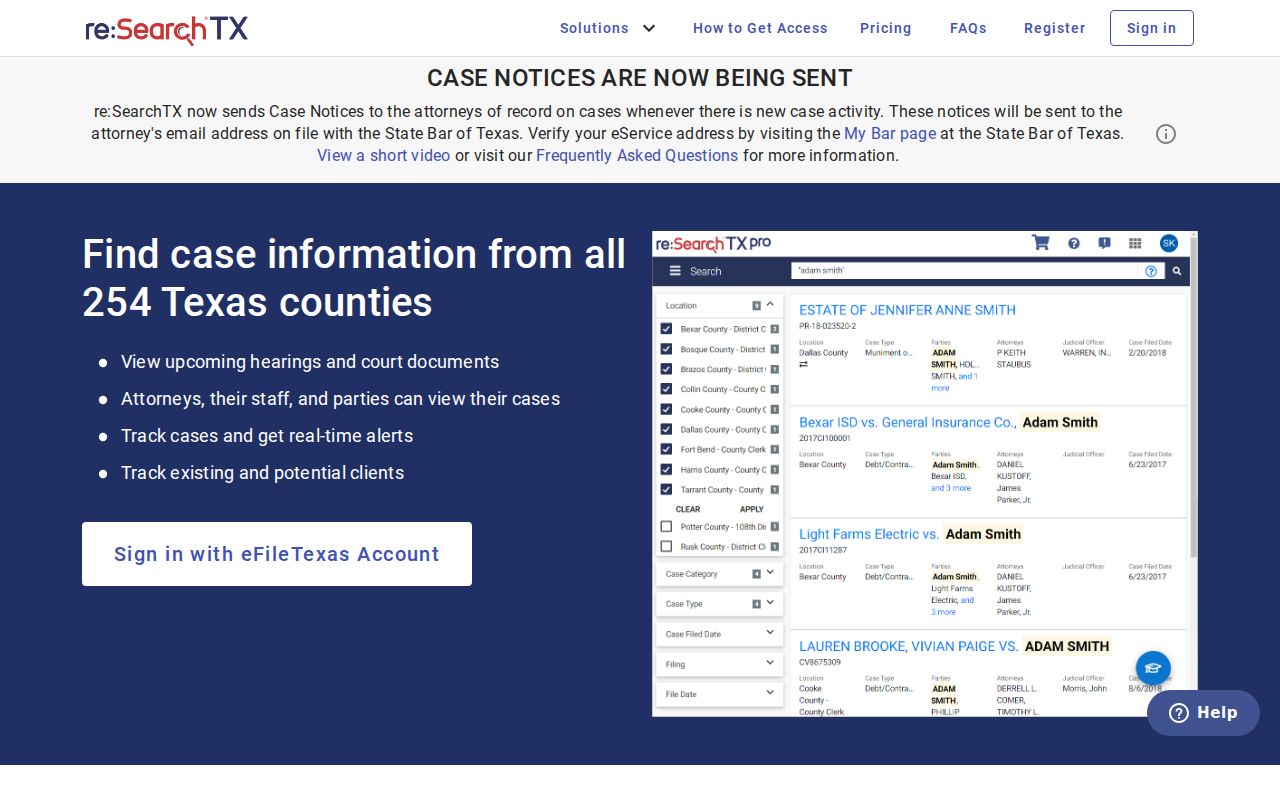
When the platform does return a Dawson County match, compare the court, cause number, filing date, status, and final event before treating it as the correct file.
Note: A no-result screen does not establish that Dawson County has no paper, archived, sealed, or nonparticipating-court record.
What the Case File Shows
A Dawson County case file is richer than a public criminal-history summary. The docket tracks filings and court action in date order. The charging instrument shows what the State chose to prosecute, while the judgment or dismissal shows the legal outcome. Plea papers, motions, bond action, hearing notices, financial entries, and later revocation or adjudication activity may also appear. Document access depends on the clerk, the system role, and lawful redaction.
| Case number and court | Identifies the cause, filing court, case type, filing date, status, and judge. |
|---|---|
| Charging document | Shows the complaint, information, or indictment, count, statute, and offense grade. |
| Docket entries | Lists motions, notices, settings, continuances, pleas, orders, and post-judgment events. |
| Hearing dates | Provides public settings, event type, and courtroom or judge when displayed. |
| Disposition and judgment | Records conviction, acquittal, dismissal, deferred adjudication, or other result. |
| Sentence and conditions | May state confinement, community supervision, fines, costs, restitution, and later changes. |
Dawson County Case Counter Hours
The District Clerk is on the fourth floor of the Dawson County Courthouse, 400 S. 1st Street in Lamesa. The office closes from noon to 1 p.m. each workday and closes one hour earlier on Friday. That local schedule matters for staff retrieval and courthouse access. Call 806-329-3315 before a long trip, give the cause number or an approximate filing year, and ask whether the file can be reviewed remotely, at a terminal, or only through staff.
The District Clerk's official page supplies the current contact and counter schedule.
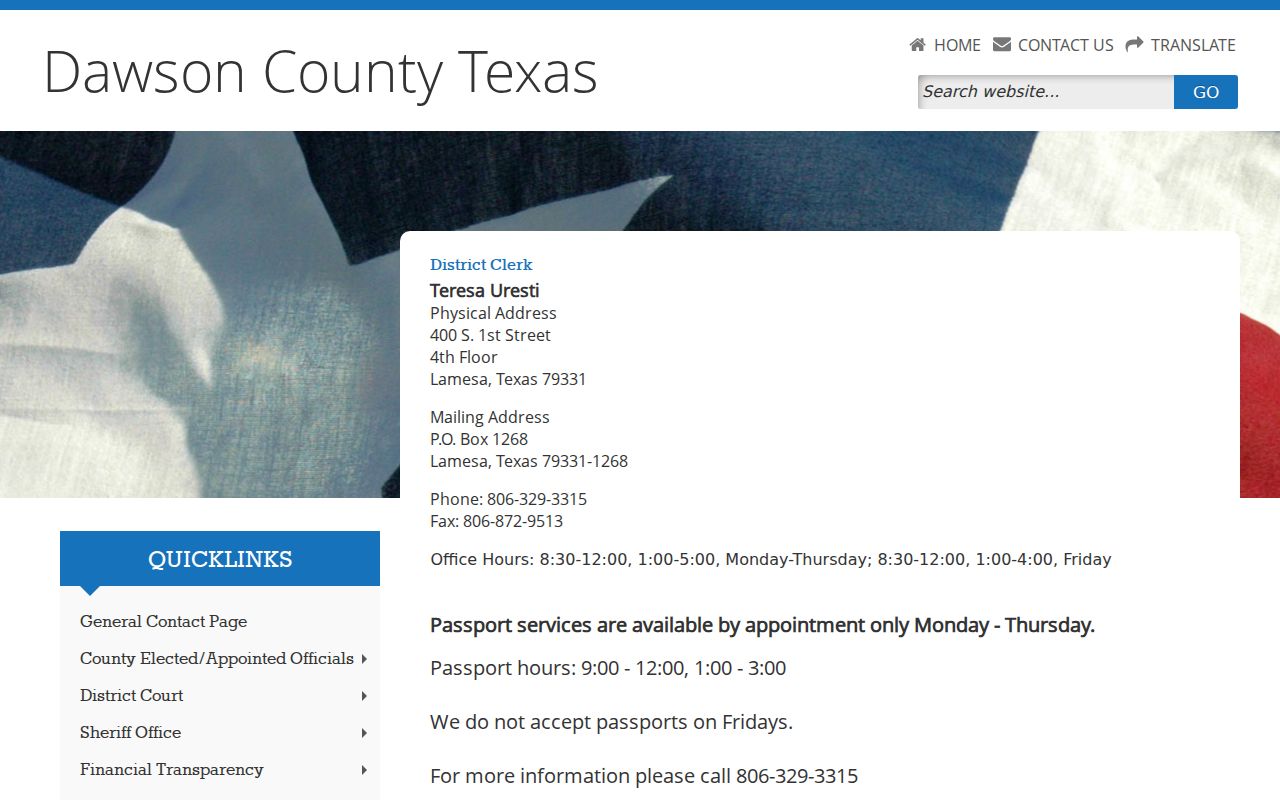
The office is open 8:30 a.m. to noon and 1 to 5 p.m. Monday through Thursday, then 8:30 a.m. to noon and 1 to 4 p.m. Friday. No official local criminal search or copy fee was found, so request a quote instead of assuming a price.
Dawson County District Clerk
Fourth floor, Dawson County Courthouse
400 S. 1st Street
Lamesa, TX 79331
806-329-3315
Fax: 806-872-9513
Stages of a Criminal Case
A Dawson County prosecution can start with arrest or summons, followed by prompt magistration. The prosecutor then reviews the event and chooses what, if anything, to file. A felony normally proceeds by grand-jury indictment. An information is common in the proper misdemeanor setting. Arraignment and plea come next, followed by discovery, motions, and talks about resolution. The case may end by dismissal, negotiated plea, or trial. Judgment, sentence, appeal, and supervision proceedings can add later docket entries.
Case flow: Charges Filed › Arraignment › Pretrial › Plea or Trial › Disposition › Sentencing
Read through the last order. A top-line charge may reflect the first filing, not the count that survived to judgment. A motion to revoke or adjudicate can also create a new phase without opening a wholly new criminal case.
Reading Dawson County Case Outcomes
Disposition means the result of a charge. A conviction is a finding of guilt. An acquittal is a not-guilty result, and a dismissal ends the filed charge without a conviction on that count. Deferred adjudication is different: the court defers a final conviction while the person serves community supervision and may dismiss the case after successful completion. It can still appear in public Texas criminal-history information unless law later restricts it.
- Docket
- The dated list of filings, settings, actions, and orders.
- Indictment
- A grand jury's formal felony accusation, also called a true bill.
- Information
- A prosecutor-filed charging instrument used for misdemeanors and certain waived-indictment cases.
- Capias
- A court writ directing arrest after a charging or post-judgment event.
- Deferred adjudication
- Supervision in which the court delays a final finding of guilt.
Ask for the judgment or dismissal order when the docket shorthand is unclear. Clerk staff can supply records, but they do not give a legal opinion about a disposition's future effect.
Dawson County Booking Charge Changes
A booking charge records the arresting agency's basis for custody at that moment. Prosecutors may reject it, replace it, add counts, or file a different grade after reviewing the evidence. A plea may resolve only some counts. The final judgment can therefore differ from both the booking entry and the first docket label. This is why a reader tracing a Dawson County arrest should follow the matter into the county arrest record channel and then back to the clerk's final court file.
The 106th District Court page is the official local source for the felony court serving Dawson County.
Match the arrest date and agency to the cause number, then read the indictment, plea, disposition, and sentence as separate events.
Access & Restrictions
Texas law favors access to public information, but not every record or field is open. Government Code Section 552.021 covers public information subject to exceptions. Court files held in a judicial capacity can also follow judicial-record rules. Juvenile law-enforcement records are generally confidential. Victim, child, driver-license, financial, biometric, and other protected details may be removed from a public copy.
An expunction under Code of Criminal Procedure Chapter 55A can remove qualifying arrest and case records. An order of nondisclosure restricts ordinary public access but does not destroy the record or block all authorized agencies. If a known Dawson County case is missing, ask the correct clerk whether it is archived, not online, under a restricted order, or indexed under a different cause or name.
Note: Public access can differ between an online docket view and the clerk's lawful paper or certified record.