
How to Check Criminal History in Lamesa
Begin with the Lamesa event, not a broad name query. The place, date, agency, and level of charge determine which Lamesa record office can answer. Lamesa police reports remain with Lamesa Police. Fine-only Lamesa traffic, parking, ordinance, and Class C misdemeanor matters stay with Lamesa Municipal Court. The Dawson County Sheriff is the practical custody source when a person was booked, and Dawson County clerks hold filed Class A, Class B, and felony cases. The Texas DPS public product adds a limited statewide view of reported convictions and deferred adjudications, but it cannot replace the local Lamesa file.
Use this five-part route for a Lamesa criminal record check:
- Call Lamesa Police and identify the incident or arrest report by date, place, subject, and report number if known.
- Ask the City Secretary how to deliver a written Texas Public Information Act request when the report is not routinely released.
- Contact Lamesa Municipal Court for a city citation or fine-only matter and request the docket or final order.
- Check the Dawson County Sheriff for custody, then the correct county clerk for charges that exceed municipal jurisdiction.
- Use the Texas DPS conviction name search or fingerprint-based personal review only for the statewide question each product can answer.
Lamesa Police Records Through City Hall
Lamesa Police does not post a report-copy form, records email, fee schedule, public blotter, or records-unit hours. Its official contact is 601 S. 1st Street, Lamesa, with the main police line at 806-872-2121, fax 806-872-4338, and Police Secretary at 806-872-4368. Call the secretary first. Ask whether the requested Lamesa police record is ready, which facts staff need, and whether inspection, email, pickup, or mail is available. A precise request should name the record type and give the incident number, date, approximate time, location, and parties as needed.
When a written Lamesa request is needed, the City Secretary at 806-872-4322 is the documented city route. State that the request seeks existing Lamesa records under Chapter 552, and choose inspection or copies. Do not send the police chief a vague demand to research a person's past. Active investigations, juvenile material, protected victim facts, driver data, and other confidential details may be withheld or redacted. A Lamesa body-camera request also needs the date and approximate time, a specific place, and at least one known subject under Texas law.
Lamesa Police Contact
601 S. 1st Street
Lamesa, TX 79331
806-872-2121
Police Secretary: 806-872-4368
City Records Route
City Secretary
601 S. 1st Street
Lamesa, TX 79331
806-872-4322
The Lamesa Police Department
Lamesa Police holds the report produced by its officers. That file can include the incident number, event date and place, alleged offense, officer narrative, involved roles, and references to evidence. If an arrest occurred, the police report and the jail booking record are still separate products. The official department page lists the chief, lieutenant, sergeants, secretary, and contact numbers, but it does not expose a searchable incident system. Nothing in the city document center turns it into a police database.
The official City of Lamesa homepage shows the municipal source used to route city business. Its captured view appears below.
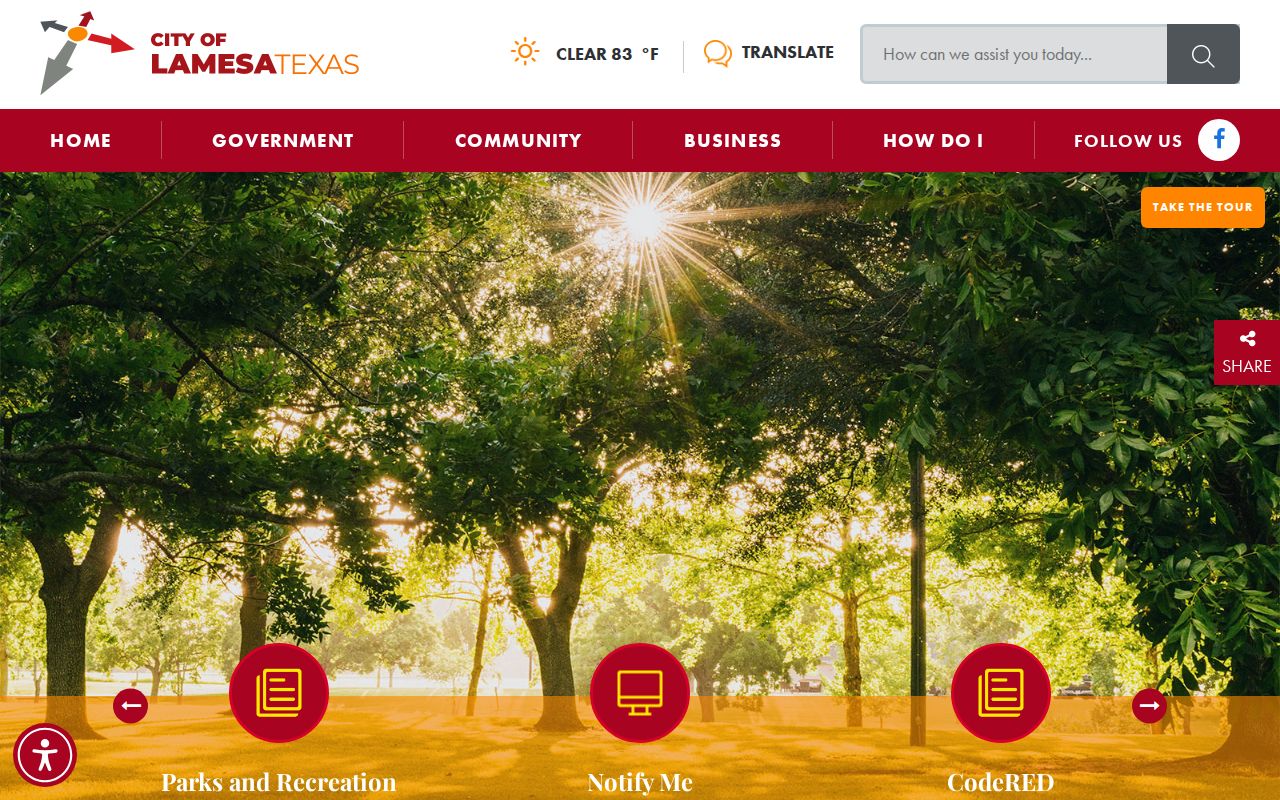
The Lamesa city page is a starting point for Lamesa offices, not proof that a Lamesa police report or court case is online. Phone confirmation remains important before sending a request or traveling.
Broken Lamesa Record Links
Two Lamesa city links can mislead a searcher. Lamesa Police advertises a free House Check form, but the researched Lamesa link returned a 404 response. The Lamesa Municipal Court page's Citations link was also malformed or unavailable. A broken link does not show that the underlying Lamesa service or court record vanished. It means the live Lamesa office must supply the current route. Call the Police Secretary for the Lamesa house-check or report channel, and call the municipal clerk for a citation file.
The Tyler payment page creates another trap. Its inspected options offered utility billing rather than court citation fields. Payment tools are built to accept a known account or obligation; they are not necessarily public docket searches. Do not use a blank payment result to infer that Lamesa has no case, balance, or warrant. Ask the court clerk to locate the matter by citation, case number, name, and date of birth where the court permits.
Note: A failed city link calls for direct verification, not a commercial people-search substitute or a guess about a case outcome.
Arrests and Bookings in Lamesa
A Lamesa officer creates the arrest report, while the receiving jail creates the booking file. Research found no Lamesa city jail roster and no official claim of a formal Lamesa booking contract. For actual Lamesa custody, call the Dawson County Sheriff at 806-872-7560 and use the sheriff-linked VINELink service where available. The Lamesa police report may show why the officer acted. The booking record may show intake time, booking charge, bond, magistrate, custody, and release. Neither is a judgment of guilt.
After prosecutors act, filed cases split by level. Fine-only city matters can remain in Lamesa Municipal Court. Class A and B misdemeanors begin with the Dawson County Clerk, while felonies go to the District Clerk for the 106th Judicial District Court. A booking charge can be changed, rejected, or narrowed. Anyone seeking the outcome should read the filed charge and final judgment or dismissal. More detail on the custody chain appears in the Dawson County arrest history resource.
Lamesa's South First Record Corridor
Lamesa's public record offices sit unusually close along South First Street, yet they do not share one file. The Dawson County Courthouse at 400 S. 1st holds the county clerks and court offices. The probation remodel was identified at 411 S. 1st. The Municipal Building, Lamesa Police, and Municipal Court use 601 S. 1st. The short distance can make the system look unified, but legal custody follows the office that made or filed each document.
For a practical search, take the report number from police to the court that received the charge. Take the cause number from the court back to the clerk when requesting a judgment. If the subject was booked, ask the sheriff for the booking identifier. This cross-check is more reliable than asking one counter for “everything.” The District Clerk also closes from noon to 1 p.m., ends public hours at 4 p.m. Friday, and handles felony files on the courthouse fourth floor. Call before a trip so staff can confirm the right counter and retrieval needs.
Lamesa Municipal Court Records
Lamesa Municipal Court hears Lamesa traffic and parking matters, city ordinance cases, and fine-only Class C misdemeanors such as certain public-intoxication and minors' alcohol matters. It does not hear Dawson County felonies or Class A and B misdemeanors. Clerk Sonia Vera can be reached at courtclerk@ci.lamesa.tx.us or 806-872-4343. No Lamesa-hosted public case portal or published copy and search fee was confirmed, so request Lamesa case access by phone, email, or the court counter.
| Court Name | Lamesa Municipal Court at the Municipal Building, 601 S. 1st Street. |
|---|---|
| Case Types Heard | Traffic, parking, ordinances, and fine-only Class C misdemeanors within city jurisdiction. |
| Case Lookup Channel | Municipal clerk by phone, email, or counter; no verified city case-search portal. |
| What the Docket Shows | Case or citation number, filed allegation, settings, plea, court action, amount due where public, and disposition. |
| Copies & Fees | No official local schedule was found; ask the clerk for availability and cost before ordering. |
Provide the citation or case number when possible. Ask specifically for the docket and final order. A payment screen is not a substitute for those records, and a paid citation page is not a complete warrant search.
Lamesa City or County Case
The charge level controls the record route. A city ordinance or Class C offense may be heard in Lamesa Municipal Court when it arose within municipal authority. A Class A or B misdemeanor belongs with the Dawson County Clerk. A felony belongs with the District Clerk and the 106th Judicial District Court. The arresting officer's employer alone does not decide the court. Lamesa Police can make an arrest tied to a county-level prosecution, and the city report then sits beside a separate county court file.
| Record question | Lamesa starting point | County route |
|---|---|---|
| Officer report | Lamesa Police | None unless a county agency made its own record |
| Fine-only city case | Lamesa Municipal Court | JP if that court issued the matter |
| Class A or B case | Police report only | Dawson County Clerk |
| Felony case | Police report only | Dawson District Clerk |
Read the court name printed on the citation, bond paper, or notice. That small detail prevents a wasted city search when the controlling file is already at the courthouse.
Where Lamesa Records End Up
A Lamesa police event can produce several Lamesa records at different times. Lamesa Police creates the incident or arrest report. The jail adds intake and bond data when there is Lamesa custody. A prosecutor decides what charge to file. The proper clerk then records the Lamesa docket, plea, orders, disposition, and sentence. Eligible fingerprint and disposition events are reported through Texas channels to DPS. Delays, charge changes, aliases, and missing reports can cause the systems to disagree.
Record flow: Lamesa Police › Dawson County Courts › Texas Department of Public Safety
For recent Lamesa activity, start with police and custody sources. For the legal outcome, use the municipal or county court file. For a limited statewide public result, use the Texas DPS Crime Records Service Criminal History Conviction Name Search. A person reviewing their own fuller Texas history should use the fingerprint-based personal-review route. Each source answers a different question, so a no-result in one is not a clean-record certificate.
Lamesa Records and County-Seat History
Lamesa's records role grew from its place as Dawson County seat. Official city history says Lamesa began in July 1903 on Frank Conner ranch land. In 1905, rival Chicago lost the county-seat vote by five votes, and people and buildings moved toward Lamesa. Mail service began in 1906, rail arrived in 1910, electricity in 1916, and incorporation followed in 1917. The city adopted a council-manager home-rule charter in 1945.
That history helps explain why both city and county files cluster in Lamesa. It does not merge their custody. The Municipal Building and police moved to 601 S. 1st in 1993, while county court records remain at the courthouse. Older local material may also fall under Texas State Library retention schedules rather than a live case portal. A genealogy or historical search should identify the government body, date span, and record series before asking for an archive search. Modern criminal matters still begin with the current police, court, sheriff, or clerk office.
Lamesa Document Search Is Not Case Search
The city document-search interface provides a “Search for file name” box, expandable categories and subcategories, and a reset control. It searches posted document titles. During research, the Police category held an employment application rather than a report-request form or incident index. The interface should not be described as a Lamesa criminal records database. It may help find posted city documents, but it cannot confirm whether a named person has a police report or municipal case.
Use the document center for the narrow task it performs. For a police record, call the Police Secretary and, if needed, route a Chapter 552 request through the City Secretary. For a fine-only court record, contact the municipal clerk. This distinction also protects against false negatives: no matching file title only means the city did not publish a document under that search phrase. It says nothing about an incident, arrest, citation, restricted file, or court disposition.
Note: Lamesa, Texas is often confused in search results with La Mesa, California, so verify the official ci.lamesa.tx.us domain before relying on a page.
Public Access Rules
The Texas Public Information Act governs many administrative and police records held by the City of Lamesa, subject to statutory exceptions. Courts may apply judicial-record rules to files kept in a judicial capacity. DPS criminal-history information follows the narrower dissemination rules in Government Code Chapter 411. These paths overlap, but they are not interchangeable. Ask for an existing record and describe it with enough detail for staff to locate it.
Key Statutes:
Texas Government Code §552.021 gives access to public information unless another law permits or requires withholding.
Texas Government Code §§411.083-.084 restrict DPS criminal-history information and define authorized dissemination.
Texas Code of Criminal Procedure Chapter 55A sets the court process for expunction of qualifying records.
Redactions can protect juveniles, victims, driver data, financial data, and details tied to an active investigation. Requesters may ask for the public portion rather than abandoning the search when some facts are withheld. The originating Lamesa office remains the best place to verify the scope and current status of its record.